


In today’s digital age, blockchain technology has become one of the most talked-about technological advances in the world. From cryptocurrencies like Bitcoin to business systems, health research, and communication technology, blockchain is transforming how people share, store, and secure data.
But what exactly is blockchain technology, and why is it considered a powerful tool for the future of society, business, and human development? Let’s break it down.
Understanding the Concept of Blockchain Technology
Technology Refers to Systems, Tools, and Knowledge
At its core, technology refers to the use of science, engineering, and knowledge to solve human problems. Blockchain is one such system designed to bring trust, transparency, and security to the internet.
Blockchain Defined in Simple Terms
A blockchain is a digital system of recording data in a way that makes it extremely difficult to hack, change, or cheat. Unlike traditional databases, which are controlled by one authority, blockchain uses a decentralized network where many computers work together.
The Role of Computers, Networks, and Data
Blockchain relies on computers and machines working in harmony through networks to maintain an unchangeable record of information.
A Brief History of Blockchain Development
Early Ideas of Distributed Systems
Before blockchain, scientists and engineers explored distributed systems—methods where many computers could work together without relying on one central system.
Bitcoin and the Birth of Blockchain in 2008
The first practical use of blockchain came in 2008 when an unknown person (or group) named Satoshi Nakamoto introduced Bitcoin, the first cryptocurrency.
Growth of New Technologies Beyond Cryptocurrency
Since then, blockchain has expanded into new technologies for business, health, education, communication, and government systems.
How Blockchain Technology Works
Blocks, Chains, and Data Structures
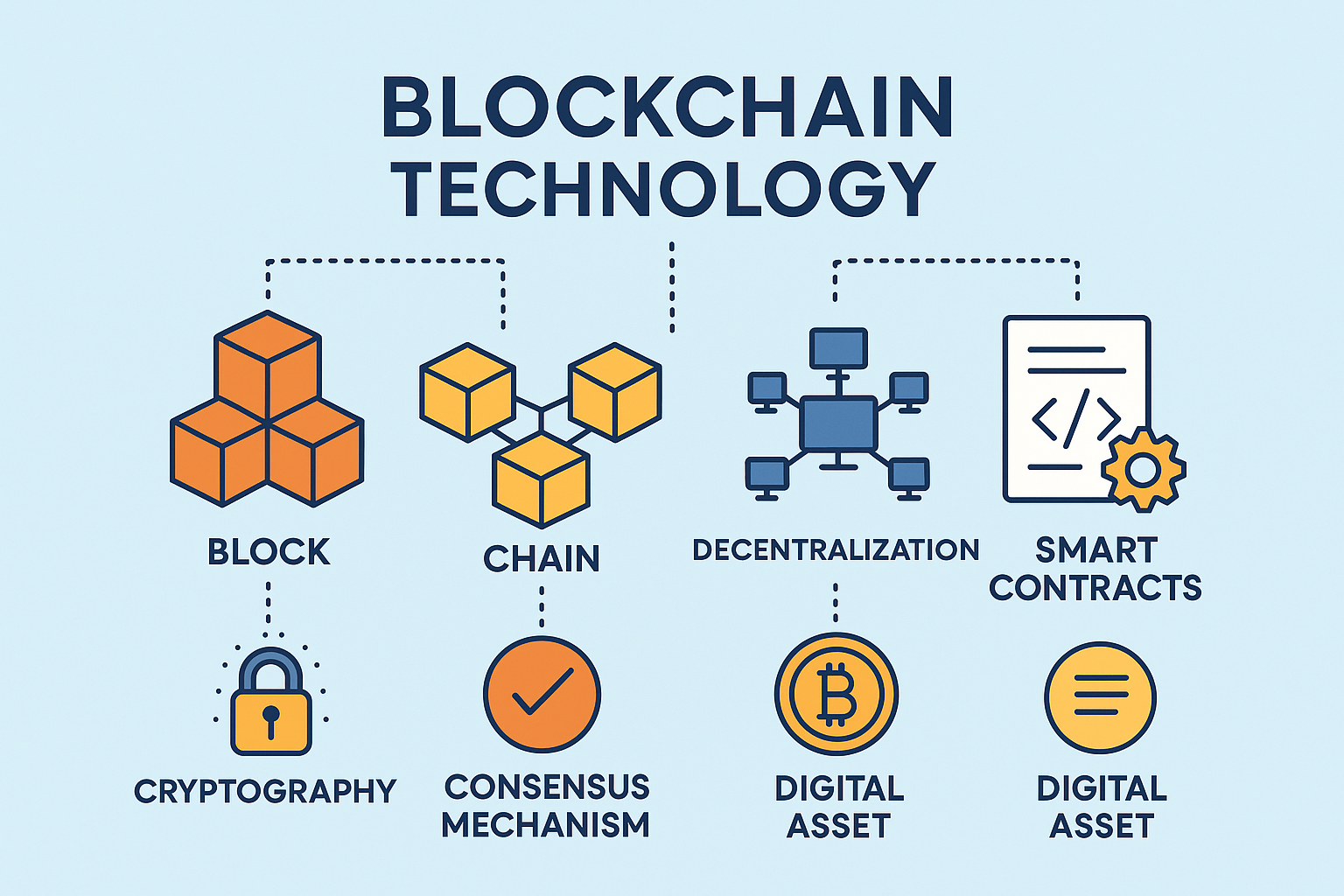
Blockchain is literally a chain of blocks. Each block stores data, such as financial transactions or medical records, and is linked securely to the block before it.
Cryptography and Security
Through cryptography, each block is locked with a unique code, making it nearly impossible for hackers to change the data.
Consensus Mechanisms: Proof of Work vs Proof of Stake
To add a block, computers must agree (a process called consensus). The two most common methods are:
- Proof of Work (PoW): Requires high energy and computational power.
- Proof of Stake (PoS): Uses less energy and is more environmentally friendly.
Core Components of Blockchain Systems
Decentralization and Peer-to-Peer Networks
Unlike traditional systems controlled by one company or government, blockchain is decentralized. That means no single person has full control—it’s a peer-to-peer system.
Smart Contracts and Automation
Smart contracts are programs stored on blockchain that run automatically when certain conditions are met. They’re used in business, health, and education to cut costs and speed up processes.
Tokens, Digital Assets, and NFTs
Blockchain allows the creation of digital tokens and NFTs (non-fungible tokens), which represent assets, art, or property ownership.
Key Features of Blockchain Technology
- Transparency and Trust – Everyone can see the records.
- Immutability and Security – Once added, data cannot be changed.
- Efficiency and Lower Costs – Reduces man in business and communication systems.
Examples of Blockchain in Daily Life
Business and Finance
Blockchain powers cryptocurrencies like Bitcoin and Ethereum, making transactions faster and cheaper compared to banks.
Health and Medical Technology
Hospitals use blockchain to store patient data securely and provide vaccine recommendations like MMRV vaccine guidelines based on scientific evidence.
Supply Chain and Manufacturing
From food to chip manufacturing, blockchain tracks goods across systems to ensure safety and quality.
Communication and Social Media
Blockchain-based platforms are emerging as alternatives to centralized social media and search engines, giving people more control over their data.
Advantages of Blockchain for Society
- Empowers people with knowledge and power.
- Brings technological advancement to business and communication.
- Supports scientific research, engineering, and educational technology.
- Ensures trust and transparency in systems like construction technology, environmental technology, and daily life applications.
Challenges and Limitations of Blockchain
- Energy consumption from mining and wind power limitations.
- Scalability issues blockchains can be slow compared to centralized systems.
- Regulations and misuse governments are still figuring out how to control fraud.
Blockchain vs Traditional Systems
Unlike traditional centralized systems, blockchain distributes power and knowledge across a network of computers, making it more secure and less prone to corruption. This marks a new chapter in human history of technological development, much like the industrial revolution or iron age transformed society.
Future of Blockchain Technology
Artificial Intelligence and Blockchain Integration
When combined with artificial intelligence, blockchain can create powerful tools for business, health, and engineering systems.
Blockchain in Government and Society
Governments are exploring blockchain systems for voting, taxes, and recommendations.
Predictions from Experts
Sources like MIT Technology Review predict blockchain will influence communication technology, environmental technology, and business development for many years ahead.
Conclusion
From the stone age to the digital age, humans have relied on tools, machines, and systems for progress. Today, blockchain technology is one of the most promising new technologies, offering transparency, security, and efficiency for the world.
What exactly is blockchain technology?
Blockchain is a decentralized digital system for recording data securely and transparently.
How is blockchain used in daily life?
It’s used in cryptocurrency, supply chains, health records, vaccine recommendations, and business communication systems.
What are the advantages of blockchain?
Transparency, security, decentralization, and efficiency.
Is blockchain only for cryptocurrency?
No. It’s used in business, medical technology, construction technology, and environmental technology.
What is the future of blockchain technology?
Blockchain will expand into AI, social media, government systems, and environmental solutions.
